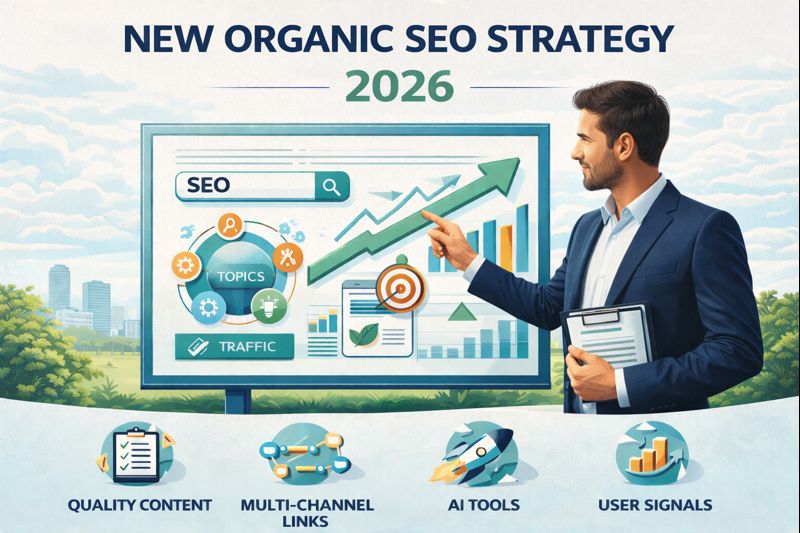
Search behavior is evolving faster than ever, and by 2026, SEO will no longer be about isolated tactics or keyword-heavy pages. Search engines are moving toward evaluating intent, credibility, experience, and long-term value. Businesses that fail to adapt will see declining visibility, while those who plan ahead will build organic growth that compounds year after year.
A future-ready Organic SEO Strategy is no longer optional. It is a structured, experience-led, and data-backed approach that aligns content, technology, and brand authority. Below are the 10 most important organic SEO strategy plans businesses must adopt in 2026 to stay competitive.
1. Build Topic Authority Instead of Isolated Rankings
Search engines no longer reward single pages ranking in isolation. They evaluate how deeply a website covers a topic.
A strong topic authority framework includes:
- One comprehensive pillar page
- Supporting content covering related subtopics
- Clear internal linking between all pages
This structure improves crawl efficiency, relevance, and long-term ranking stability.
If your website still relies on standalone blogs, it’s time to restructure for authority.
2. Optimize for Search Experience, Not Just Search Engines
Search Experience Optimization (SXO) is becoming a core ranking factor. Pages that frustrate users lose visibility over time.
SXO focuses on:
- Clear content hierarchy
- Scannable layouts
- Fast load times
- Easy navigation to key actions
SEO and user experience are no longer separate disciplines in 2026.
3. Prioritize Search Intent Over Exact Keywords
Exact-match keywords are losing importance. Search engines now group queries by intent and context.
To rank consistently, content must:
- Fully answer the user’s main question
- Address related follow-up queries
- Match the user’s decision stage
Pages that only partially satisfy intent will struggle to compete.
4. Create Content That Educates Before It Sells
Overly promotional content is increasingly filtered out of organic results. Educational depth now drives visibility.
High-performing content:
- Solves real problems
- Builds trust before conversion
- Demonstrates expertise clearly
- Supports informed decision-making
Sales messaging should support content, not dominate it.
5. Use Data to Guide SEO Decisions, Not Assumptions
SEO strategies in 2026 must be data-driven. Rankings alone are no longer reliable success indicators.
Metrics that matter more include:
- Engagement time
- Scroll depth
- Return visits
- Assisted conversions
- Growth in branded searches
Traffic without engagement sends weak quality signals.
6. Strengthen Technical SEO for Scale and Stability
Technical SEO is still critical, but its role has shifted toward enabling experience and scalability.
Priority technical areas include:
- Core Web Vitals optimization
- Clean site architecture
- Crawl budget efficiency
- Structured data implementation
- Indexation control for large sites
Technical SEO works best when aligned with content strategy.
7. Use Automation to Scale SEO Efficiently
Manual SEO processes cannot keep up with growing websites.
High-performing SEO teams use automation for:
- Internal linking
- Metadata optimization
- Schema generation
- Performance monitoring
Automation frees time for strategic planning and analysis.
8. Build Brand Authority as a Ranking Signal
Search engines increasingly reward brands users recognize and trust.
Strong brand signals include:
- Higher click-through rates
- Increased branded searches
- Better engagement metrics
- Consistent visibility across channels
SEO strategies must actively support brand-building efforts.
9. Refresh and Upgrade Content Instead of Publishing Excessively
Refreshing existing content often delivers better results than publishing new pages.
Effective content upgrades include:
- Updating outdated statistics
- Expanding thin sections
- Improving readability
- Adding FAQs and structured data
Content Update Action | SEO Impact |
Updating old data | Higher relevance |
Expanding depth | Better engagement |
Improving UX | Lower bounce rate |
Adding FAQs | Snippet visibility |
Content improvement compounds value over time.
10. Balance AI Capabilities With Human Strategy
AI tools are becoming standard in SEO workflows, but strategy remains human-led.
AI is effective for:
- Keyword clustering
- Content outlines
- Technical audits
- Performance tracking
Humans remain essential for:
- Strategic judgment
- Brand voice
- Original insights
- User empathy
The strongest Organic SEO Strategy combines automation with human expertise.
Why These Strategies Matter More in 2026
SEO is no longer a checklist—it is a system. Brands that treat SEO as an ongoing business strategy outperform those chasing short-term tactics. These 10 strategy plans align with how search engines evaluate trust, relevance, and experience moving forward.
Ready to future-proof your organic growth? Start building strategies designed for 2026—not yesterday.
How BestoSEO Solutions Helps Businesses Prepare for the Future of SEO
At BestoSEO Solutions, SEO is approached as a long-term growth framework rather than a tactical service.
The focus includes:
- Intent-driven content systems
- Conversion-focused optimisation
- Scalable technical foundations
- Continuous performance tracking
The goal is sustainable visibility, consistent traffic, and measurable business growth.
Final Words
SEO in 2026 will reward clarity, credibility, and consistency. Brands that succeed will be those that understand user intent, invest in experience, and build authority over time. A well-executed Organic SEO Strategy integrates content, technology, and trust into a single growth engine.
If you want to stay competitive, visible, and relevant in the years ahead, now is the time to rethink how you approach organic search.
Contact us today and start building an SEO strategy designed for long-term success.
FAQs
SEO strategies should be reviewed quarterly, with continuous monitoring of performance data and user behaviour.
Yes. Focused topical authority, strong user experience, and consistent content can help smaller brands compete effectively in niche markets.
Yes. AI-driven search increases the importance of authoritative, well-structured, and experience-focused content rather than reducing SEO value.